

Last updated on 26 November 2026 · 10 min read
The main applicant must show €2,400 a month, which is €28,800 for the first year. Each family member adds €600 a month, or €7,200 a year. These are the amounts for 2026 under article 62 of the Immigration Regulation, checked on 25 November 2026.
Pensions, rental income, dividends and savings can all count. Income from work, including remote work for a foreign employer, does not.
Key facts
- Main applicant. 400% of the IPREM, which is €2,400 a month (€28,800 a year).
- Each family member you support. 100% of the IPREM, which is €600 a month (€7,200 a year).
- The IPREM in 2026. €600 a month. It has not changed since 2023 because the 2023 Budget has been extended.
- First permit. One year from the date you enter Spain. Renewals last two years.
- Renewal. Enough money for the two-year period and more than 183 days a year living in Spain.
- Law. Organic Law 4/2000, articles 30 bis and 31, and the Immigration Regulation (Royal Decree 1155/2024), articles 61 to 64. Consolidated text on the BOE.
The non-lucrative visa is the route most retirees and people living on their own means use to move to Spain from outside the European Union. Applications often fail not because the applicant lacks the money, but because of how it is shown. The usual causes are the wrong kind of income, statements that do not cover the period the consulate asks for, or a balance that dips below the threshold after an exchange-rate move. This guide sets out the rule, what consulates accept in practice and what changes when you renew.
In this guide
How the financial requirement is calculated
Article 62 of the Immigration Regulation ties the requirement to the IPREM, the public income indicator Spain uses for benefits and thresholds. You need 400% of the IPREM each month for yourself and 100% for each family member who depends on you. The regulation then asks for the monthly figure multiplied by the length of the permit you are applying for. The first permit lasts one year, so you need twelve months’ worth.
The IPREM is set by the State Budget. Because Spain has extended the 2023 Budget, it has stayed at €600 a month in 2024, 2025 and 2026 (State Budget Act for 2023). If a new Budget changes it, the amounts below change with it, so check the figure in force on the day you apply.
| Household applying | Per month | First year (12 months) | Renewal (24 months) |
|---|---|---|---|
| You alone | €2,400 | €28,800 | €57,600 |
| You + 1 family member | €3,000 | €36,000 | €72,000 |
| You + 2 family members | €3,600 | €43,200 | €86,400 |
| You + 3 family members | €4,200 | €50,400 | €100,800 |
| You + 4 family members | €4,800 | €57,600 | €115,200 |
These are minimums. The regulation allows the amount in euros or its equivalent in another currency, which means the consulate will convert your pension or balance at the rate on the day it reviews the file. If your income is in pounds or dollars and sits just above the line, a weaker currency can take you below it. A margin of 10 to 15% is sensible.

What counts: regular income or savings
The regulation accepts either enough money for the whole period or a regular source of income. In practice that covers the following.
- State and private pensions, shown with the award letter and recent payments into your account.
- Rental income from property you own, in Spain or abroad, backed by the lease agreements and your tax return.
- Dividends, interest and other investment income that arrives without you working for it.
- Savings in current or savings accounts, in your name and available to you.
- Shares in companies based in Spain, if the company certifies that you do not work for it and you sign a declaration to that effect.
Consulates generally accept a combination, for example a pension that covers part of the amount and savings for the rest, provided the total reaches the figure for the year. The regulation also lists property titles, certified cheques and credit cards with a bank certificate of the available limit as valid evidence. Consulates look for money you can actually live on, so a house or a credit limit on its own rarely carries an application.
What does not count
- A salary or fees from work you keep doing, wherever the employer or client is based. The permit is for people who live in Spain without working.
- Remote work. The Spanish Consulate General in Edinburgh puts it plainly. Working remotely is contrary to the nature of this visa (consulate page). If you plan to keep working online, the digital nomad route is the one to look at.
- Retirement accounts you cannot yet draw on. Some US consulates, Boston for example, do not accept an IRA or 401(k) as proof unless you are officially retired (consulate page).
How to prove it: what consulates ask for
You apply at the Spanish consulate for the place where you live, not from Spain, and each consulate publishes its own list. The legal threshold is the same everywhere; the paperwork is not. Before you gather anything, read your consulate’s page line by line.
| Consulate | Bank statements asked for |
|---|---|
| Washington | Last 3 months, all accounts (checking, savings, investment) |
| Los Angeles | Last 3 months, plus your latest tax return |
| Houston | Last 12 months, with a stable balance at or above the minimum |
| Edinburgh | 12 months if you rely on savings |
Whichever consulate you deal with, these points apply.
- Foreign accounts. Article 62.3 asks for the bank’s full name and address, the account details, the opening date and, the point most people miss, the balance on 31 December of the previous year and the average balance over the last year. Ask your bank for a certificate that shows all four.
- Large recent deposits will be questioned. If you moved money between accounts or sold an asset, include the paperwork that explains where it came from.
- Translations and apostilles. Foreign public documents need an apostille or legalisation and, where the consulate requires it, a sworn translation into Spanish. Some consulates exempt bank statements from translation; others do not.
- Health insurance is a separate requirement, but it is where many files fail. US consulates ask for a policy with an insurer authorised in Spain, with no co-payments, no deductible and no waiting period, covering at least a year. UK pensioners can use a registered S1 form instead.
Three worked examples
1. A retired couple living on two pensions
Their pensions add up to the equivalent of €3,400 a month. As a household of two they need €3,000 a month, so they meet the requirement with a reasonable margin. They file both pension award letters, statements showing the payments arriving and a short cover letter adding up the figures.
2. A single applicant relying on savings
She has €40,000 in a savings account and no income. The first year needs €28,800, so the visa is fine. The risk comes a year later, because renewal needs €57,600 for two years. If she has spent €12,000 and has €28,000 left, she will not reach the figure on savings alone. The time to plan for renewal is before she moves.
3. A family of four with rental income and savings
Two adults and two children need €4,200 a month, or €50,400 for the first year. Their flat in Manchester brings in the equivalent of €1,800 a month, €21,600 a year, and they hold €32,000 in savings. Together that is €53,600, above the threshold. They show the lease, the tax return that declares the rent and twelve months of statements.
Why applications get refused
- The figure is met only on paper, for example through a balance that fell below the minimum during the months the consulate reviews.
- The income comes from work, or the file suggests you will keep working remotely.
- Statements do not cover the period your consulate asks for, or show unexplained transfers just before applying.
- The health policy has co-payments, waiting periods or is travel insurance.
- Documents lack an apostille or a translation the consulate requires.
- You applied at a consulate that does not cover the place where you live.
Renewal: what changes after the first year
You can apply to renew in the two months before your permit expires, or up to three months after, although applying late can lead to a fine. A renewed permit lasts two years (Ministry of Inclusion, sheet 7). To renew you need the following.
- Enough money for the two-year renewal period, which is €57,600 for you and €14,400 for each family member if you rely on savings.
- To have lived in Spain for more than 183 days in the calendar year.
- To have kept your health insurance throughout the first permit.
- Children of compulsory school age enrolled in school while they are in Spain.
Spending more than 183 days a year in Spain also makes you a Spanish tax resident under article 9 of the Personal Income Tax Act. From that point Spain taxes your worldwide income, and you may have to declare assets held abroad. Plan this with an adviser before you move. Our tax guides cover the basics.
Checklist before you book the appointment
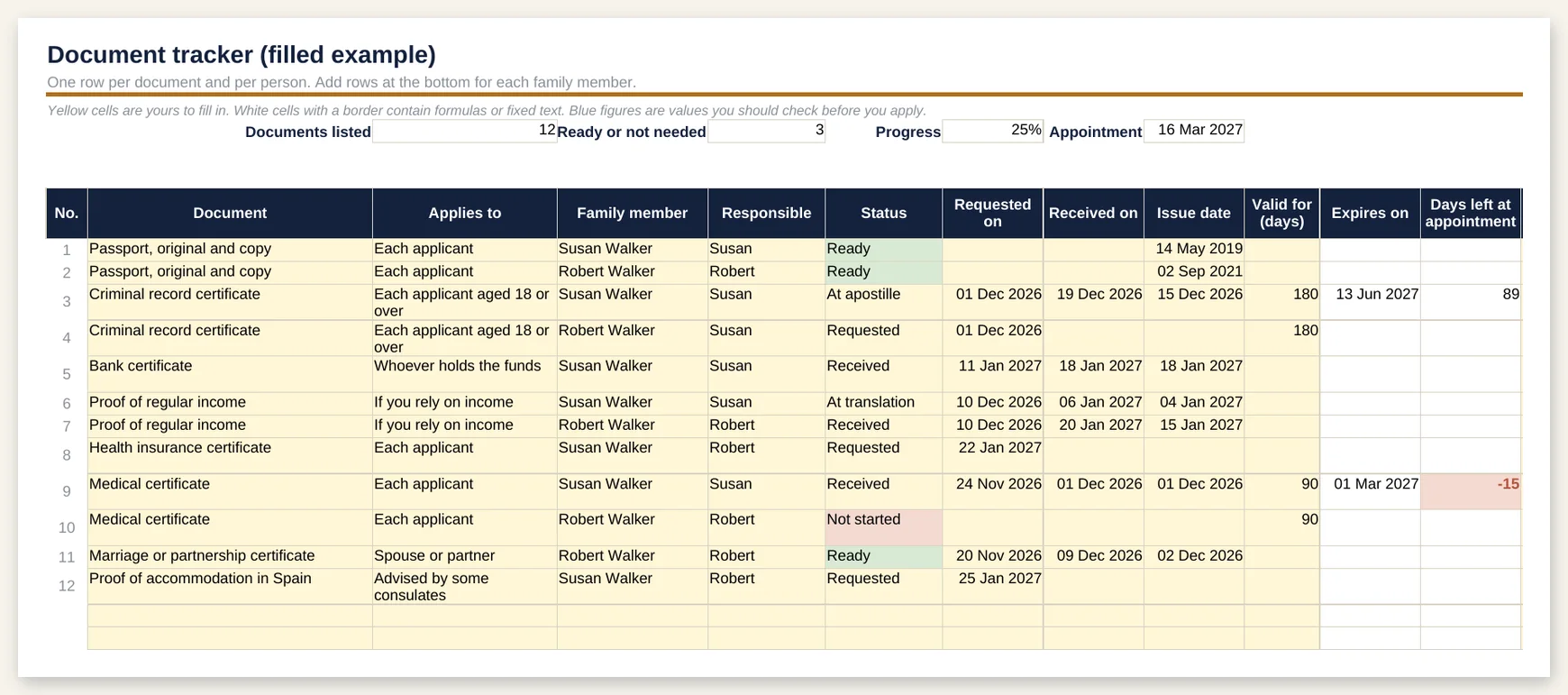
Keep the whole file in one workbook. Our Spain Non-Lucrative Visa Document Kit tracks each document for each family member, logs your financial evidence, translations and apostilles, and includes two email models. A free sample of the tracker is on the same page.
Frequently asked questions
Can I work remotely on Spain’s non-lucrative visa?
No. The permit is for people who live in Spain without working, and consulates read remote work as work. If you want to keep working for a foreign employer or clients, the digital nomad visa is the route designed for that.
How much do I need for a child or a spouse?
€600 a month, or €7,200 a year, for each family member who depends on you, on top of the €2,400 a month for the main applicant. A couple with one child therefore needs €3,600 a month or €43,200 for the first year.
Does the money have to be in a Spanish bank account?
No. Foreign accounts are accepted. The regulation asks for the bank’s details, the account details, the balance on 31 December of the previous year and the average balance over the last year, so ask your bank for a certificate that shows them.
Will the amount change in 2027?
Only if the IPREM changes. It is fixed in the State Budget and has stayed at €600 a month since 2023. If a new Budget raises it, the amounts for the non-lucrative visa go up the same day, so check before you apply.
Can I combine a pension and savings?
Consulates generally accept a combination, provided the total covers the period. A pension that covers part of the monthly figure plus savings for the rest of the year is a common way to meet the requirement.
Choosing this route when you plan to keep working remotely is the most common mistake we see. Our guide to the seven mistakes to avoid when moving to Spain explains why, and our guides for UK and US households walk through the whole move.
What to read next
This guide explains the general rules. It is not legal advice for your situation, and consulates can ask for more than the minimum. Read our disclaimer.
Written by Estela Cortés Cortillas, lawyer, Barcelona Bar (ICAB no. 47590). Last reviewed on 26 November 2026.