

Last updated on 26 November 2026 · 9 min read
You can move to Spain from the UK, but since 1 January 2021 a British passport alone does not give you the right to live here. Unless you have an EU passport, a qualifying family link or rights from living in Spain before 2021, you need a national visa for the purpose of your move, applied for at the Spanish consulate that covers your UK address before you travel.
Key facts
- As a British visitor you can stay up to 90 days in any 180-day period. Living, working or studying for longer needs a visa or other residence permission.
- The consulate is chosen by your address. London, Manchester and Edinburgh each cover their own district, and visa applications go through BLS.
- UK documents usually need an apostille from the FCDO Legalisation Office and a sworn translation into Spanish.
- After arrival, the padrón, the TIE card and your health cover each have their own office and their own evidence.
On this page
Can you move to Spain from the UK?
If you hold a British passport and are moving now
A holiday and a move are different legal events. As a visitor you can spend up to 90 days in any rolling 180-day period across the Schengen area, and that time does not build towards residence. Once your plan is to live in Spain, the question becomes which residence route fits the purpose of your move, and the answer is decided by the Spanish consulate for the district where you live in the UK, not the one nearest to you.
Start with the UK government’s Living in Spain guide and then read the route itself on the Spanish side. Our overview of Spanish visa types sets the main routes side by side.
If you have EU citizenship, a family connection or protected rights
Three situations change the starting point. If you also hold the passport of an EU country, such as an Irish passport, you register as an EU citizen in Spain and do not need a national visa. If your spouse or partner is an EU or Spanish citizen, the family rules for relatives of EU citizens may apply. If you lived in Spain lawfully before 1 January 2021, the Withdrawal Agreement protects your residence, and your card shows it.
Keep the facts of each case with the authority that decides it. A family route depends on the sponsor’s status and the documents that prove the relationship, and our guide to family reunification explains the ordinary route for relatives of non-EU residents.
Which residence routes should you compare?
| Your situation | Route to read | What to check first |
|---|---|---|
| You will live on savings, a pension or rental income and will not work | Non-lucrative residence | The income figure for your household, health cover and that the route does not allow work |
| You work remotely for an employer or clients outside Spain | Digital nomad (telework) visa | Income against the 2026 figures, how long the relationship has run and your Social Security position |
| You have a job offer from a Spanish employer | Employee work authorisation | Who applies (usually the employer) and in which order |
| You will run your own business in Spain | Self-employed work authorisation | The business plan and the evidence the office asks for |
| You will study | Student visa | Admission, funds, health cover and any work allowed alongside studies |
| You are joining a relative | Family routes | The sponsor’s status and the relationship documents |
Remote work and non-working residence
These are the two routes most British readers compare. Non-lucrative residence is for people who can support themselves without working; it does not allow remote work for a UK employer. The digital nomad visa is built for that remote work, with its own income test and a requirement to show the company or client relationship. If your plans could change during the first year, read both before you pay for anything that depends on one of them.
Work for a Spanish employer, run a business, study or join family
Each of these has its own application order. For a Spanish job, the employer normally starts the work authorisation in Spain before you apply for the visa. For self-employment, the business plan is part of the file. The immigration regulation sets the categories, and the consulate’s visa pages list the documents for each.
What to organise before the visa appointment
London, Manchester or Edinburgh
Find your district on the Spanish Embassy’s list of UK consulates. Each consulate publishes its own checklist and fee, and visa applications are taken by its BLS centre. A standalone NIE, if you need one before you go, is handled by the consulate itself, and Edinburgh asks you to request the NIE before you book the visa appointment. Our NIE guide explains when the visa process assigns a number for you.
Passport, letters, certificates and Spanish translations
Three UK authorities produce most of the documents. ACRO issues the police certificate for a visa, the General Register Office issues birth and marriage certificates, and the FCDO Legalisation Office adds the apostille. A sworn translator authorised by the Spanish Ministry of Foreign Affairs translates them into Spanish.
The order matters because many certificates are accepted only if issued within a set time before you file. Ask the consulate how recent each document must be, then work backwards from your appointment date before you order anything.
Before you book the visa appointment
Your ticks are saved in this browser only.
Plan the move before you pay
Housing and cash
Budget for more than the first rent. A long-term lease of a home usually asks for a deposit of one month’s rent under Article 36 of the Urban Leases Act, plus up to two more months as an additional guarantee, and the landlord holds that money until you leave. Temporary accommodation for the first weeks, removal quotes, translation fees and exchange costs come on top.
- Documents and translations (£600)
- €690.00
- Removals (£2,400)
- €2,760.00
- Travel (£500)
- €575.00
- Refundable deposit
- €1,400.00
- Temporary housing
- €720.00
- First month’s rent
- €1,400.00
- Health cover, transfers, driving, contingency
- €1,200.00
- Cash needed before the first payslip or pension
- €8,745.00
Before you send a deposit, read our checks before paying for a rental, and treat any email that changes the bank details as suspect until you have confirmed it by phone, as explained in our note on changed bank details.
Travel, removals, driving and pets
A UK licence can be used for six months after you become resident and can then be exchanged without a test under the agreement in force since March 2023; our guide on driving with a foreign licence sets out the timing. For pets, GOV.UK explains the animal health certificate, which must be issued shortly before travel, after the microchip and rabies vaccination. Ask every removal company for its cancellation terms in writing before you pay a deposit.
What to organise after you arrive
- PadrónRegister at the town hall once you have an address
- TIEFingerprints at the police within one month of entry
- HealthHealth card or private cover, depending on your route
- BankAccount opened with your NIE and address
- LicenceExchange or tests before the six-month limit
Padrón, NIE and TIE
Three different things, three different offices. The padrón is your registration at the town hall where you live; our padrón guide explains the documents. The NIE is your identification number. The TIE is the card that proves your residence, applied for at the police after you arrive with a national visa. Do them in the order your route requires, and keep every receipt.
Healthcare and banking
UK state pensioners can usually register an S1 form for public healthcare in Spain, and GOV.UK’s healthcare page explains how. Other residents need either Spanish Social Security registration through work or the private cover their visa required. Banks ask for identification, proof of address and the source of funds, and each bank sets its own list.
Tax and day-to-day records
Spain treats you as tax resident if you spend more than 183 days here in a calendar year or if your main centre of interests is here, and the UK applies its own statutory residence test. Tell HMRC that you are leaving and keep a dated record of travel, work and housing from the first day. Our guide to tax residency explains the Spanish tests, and inbound workers should read about the Beckham regime before they start work.
Questions before you start
Can I arrange everything before I leave?
Most of the visa file, yes. The police certificate, apostilles, translations, insurance and income evidence are prepared in the UK. The padrón, the TIE card and in practice your bank account need a Spanish address or your attendance in Spain, so they come after you arrive.
What if my moving date changes?
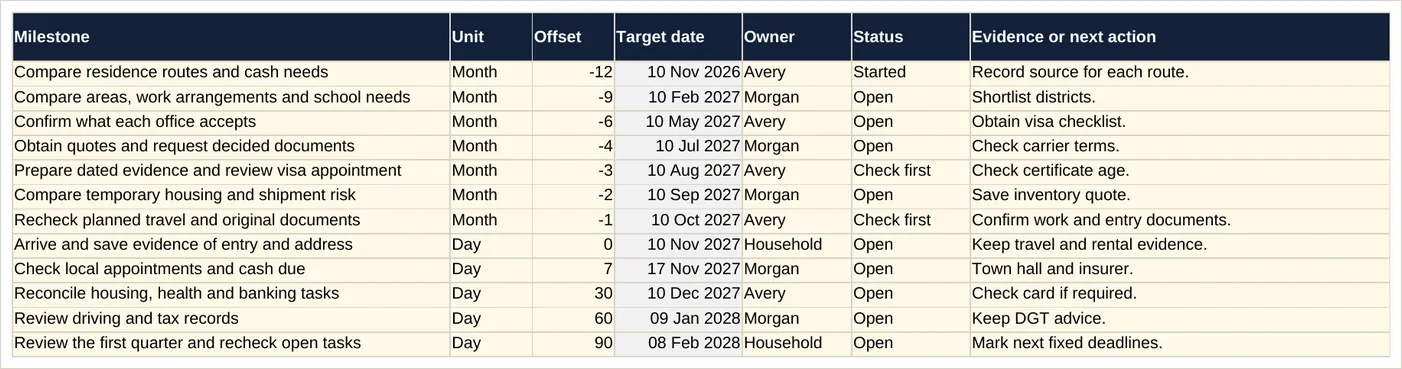
Recheck how recent each certificate must be and whether the consular fee has changed, and keep official deadlines separate from your own targets. The Move to Spain Planner, UK Edition recalculates every target date from your arrival date and keeps official dates in their own log.
Do I need an NIE before I move?
Only if something you do before the visa needs it, such as buying property or signing certain contracts. Many visa routes assign a number as part of the process. Our NIE guide explains the difference.
Can I still buy a house to get residence?
No. Spain closed the investor residence route linked to property purchases in 2025. Our guide on the end of the golden visa explains what happens to existing permits.
GOV.UK, Living in Spain · European Commission, Withdrawal Agreement residence · Immigration regulation, RD 1155/2024 · Law 14/2013, telework · UK consular districts · GOV.UK, getting a document legalised · Urban Leases Act, Art. 36 · GOV.UK, UK licence holders living in the EU · GOV.UK, healthcare in Spain · HMRC, tax if you leave the UK · Tax Agency, tax residence
What to read next
This guide explains the general rules. It is not legal advice for your situation, and each office can ask for more than the minimum. Read our disclaimer.
Written by Estela Cortés Cortillas, lawyer, Barcelona Bar (ICAB no. 47590). Last reviewed on 26 November 2026.